
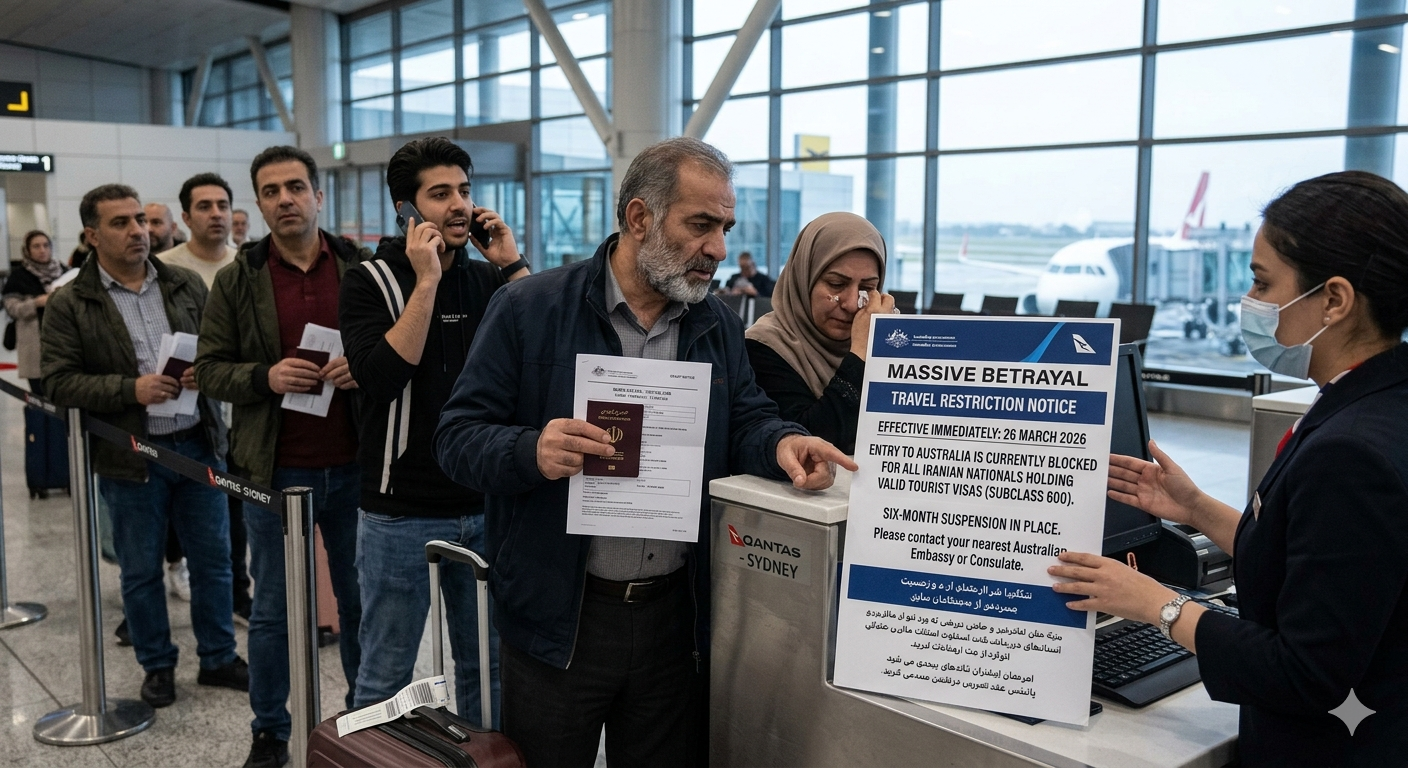
The Australian migration landscape has been rocked by a decision described by humanitarian groups as a “massive betrayal.” In a swift and controversial move, the Albanese government has enacted a six-month suspension on entry for Iranian nationals who currently hold valid tourist visas. This unprecedented restriction, which effectively freezes the travel plans of approximately 6,800 to 7,200 individuals, marks a significant shift in how Australia manages its borders during periods of global volatility.
The Emergency Legislation: Arrival Control Determinations
The legal mechanism used to enforce this block is the newly minted Arrival Control Determination, a power granted under the Migration Amendment (2026 Measures No. 1) Act. This act allows the Home Affairs Minister, currently Tony Burke, to temporarily suspend the effect of certain visas for specific classes of people.
| Feature | Details of the Determination |
|---|---|
| Affected Nationality | Iranian nationals (holding Iranian passports) |
| Visa Type | Visitor (Subclass 600) visas |
| Duration | Initial period of six months |
| Effective Date | March 26, 2026 |
| Reasoning | Escalating conflict in the Middle East and risk of visa overstays |
For the thousands of Iranian nationals who had already undergone the rigorous process of obtaining valid tourist visas, the sudden announcement felt like a door being slammed in their faces. Many had booked flights, paid for accommodation, and arranged to visit family members in Australia, only to find their valid tourist visas were no longer a guarantee of entry.
Why is the Australian Government Blocking Iranian Nationals?
According to Home Affairs Minister Tony Burke, the decision was made in the "national interest." The government argues that the intensifying war involving Iran, the US, and Israel has created a "heightened risk" that Iranian nationals entering on temporary stays may be "unable or unlikely" to depart Australia when their visas expire.
The government’s primary concerns include:
Visa System Integrity: Preventing the migration system from being used as a de facto asylum pathway.
Overstay Risks: Fearing that visitors will be unable to return to a conflict zone once their six-month stay concludes.
Deliberate Policy: Ensuring that permanent stays in Australia are "deliberate decisions" rather than a "random consequence" of someone happening to have a valid tourist visa at the start of a war.
The Home Affairs Minister emphasized that many of these valid tourist visas were issued before the current level of conflict erupted. He suggested that if those same Iranian nationals applied today, their applications might not be successful under the current risk assessment.
The Impact on the Iranian Community
The fallout from this six-month ban has been immediate. Families have been separated, and the Iranian nationals caught in the middle are facing immense uncertainty. While the government has promised "sympathetic consideration" for certain cases—specifically the parents of Australian citizens—the process to obtain a Permitted Travel Certificate (PTC) is described as narrow and discretionary.
Financial Loss: Many Iranian nationals have lost thousands of dollars in non-refundable travel costs.
Emotional Distress: Families expecting reunions for holidays or significant life events are now facing a six-month wait or longer.
Legal Limbo: Individuals with valid tourist visas are technically not having their visas "cancelled," but the visas "cease to be in effect" for the duration of the order.
Criticism and Claims of a ‘Massive Betrayal’
Humanitarian organizations and legal experts have not held back in their criticism. The Asylum Seeker Resource Centre (ASRC) labeled the move a “massive betrayal” and a “breathtaking moral failure.” Critics argue that Australia is turning its back on people precisely when they are most vulnerable due to the conflict in their home country.
"To block Iranian nationals who have already been vetted and granted valid tourist visas is to undermine the very integrity the government claims to be protecting. It is a massive betrayal of the trust these individuals placed in the Australian migration system." — Human Rights Advocate Statement.
Professor Sarah Joseph of Griffith University went further, calling the decision "disgusting," particularly as it punishes regular citizens for geopolitical conflicts beyond their control. There is also a pointed irony noted by Senator David Shoebridge, who highlighted that the government recently welcomed members of the Iranian women’s football team while now blocking thousands of other Iranian nationals from using their valid tourist visas.
Exemptions and the "Permitted Travel Certificate"
The six-month block does not apply to everyone. The government has carved out specific exemptions for those most closely tied to Australia.
Onshore Iranians: Those already in Australia on March 26 are not affected.
Immediate Family: Spouses, de facto partners, and dependent children of Australian citizens or permanent residents.
Transit Travelers: People who had already commenced their journey to Australia.
PTC Holders: Those granted a special travel certificate by the Home Affairs Minister.
To apply for a Permitted Travel Certificate, Iranian nationals must demonstrate "compelling and compassionate" circumstances. However, migration agents warn that these are being issued in "extremely limited" numbers, leaving most of the 6,800 affected people stranded for the next six months.
The Road Ahead: What Happens After Six Months?
The current Determination is set to expire in late September 2026. However, the law allows the Home Affairs Minister to renew the order if the conflict persists. This means the six-month block could potentially be extended, leaving Iranian nationals in a state of perpetual waiting.
For those whose valid tourist visas expire during these six months, the situation is even more dire; they will be required to lodge entirely new applications and pay new fees once the restrictions are eventually lifted, with no guarantee of a refund for their previous visa.
The "massive betrayal" felt by the community highlights a growing tension between national security and humanitarian obligations. As the Home Affairs Minister continues to monitor global developments, the lives of thousands of Iranian nationals remain on hold, tethered to a valid tourist visa that currently carries no power to get them past the Australian border.
Would you like me to help you draft a letter to a Member of Parliament regarding these visa restrictions?
Australia blocks Iranian visitors for six months
This video provides a news report on the Australian government's decision to implement the temporary travel ban for Iranian passport holders.
Related News
-
05-Aug-2024
PIA Starts Direct Flights To Jeddah from Faisalabad To Facilitate Pilgrims
-
21-Oct-2025
UAE Visa Ban 2025: Suspended Visas for Nine Countries
-
27-May-2025
Staying Healthy on Holy Ground: Singapore Updates Haj and Umrah Vaccination Requirements
-
08-Feb-2023
UAE Launches New Visa Validity Extension Service Online
-

07-Jan-2020
Top 5 Religious Tourist Places in Pakistan
-

11-Feb-2025
Pakistani Umrah Pilgrims Offloaded Due to Lack of Polio Vaccination Certificates
-

21-Aug-2019
5 Finest Villas in Murree
-
.webp)
19-Jun-2025
How Many Pakistanis Perform Umrah Every Year
-
30-Jun-2025
Citizenship by Investment Programs for Pakistanis in 2025: A Comprehensive Guide
-
04-Apr-2025
Reopening of Embassy in Islamabad for Migration Matters
-
29-Aug-2025
Karachi Airport Flooding: What to Know About Flight Delays
-

25-Sep-2025
Why Schengen Countries Require Travel Insurance When Applying for a Visa from Pakistan
