
The landscape of international travel is undergoing a massive transformation this week. From the implementation of cutting-edge digital systems in Europe to significant fee adjustments in the United Kingdom, staying informed on Visit Visa Updates This Week is crucial for every global traveler. As of April 1, 2026, several major economies have flipped the switch on new regulations that prioritize biometric security and streamlined digital processing.
Below is a comprehensive breakdown of the most critical changes affecting Visit Visa Updates This Week, including the latest visit visa updates, new visa regulations, and the specific visa policy changes you need to navigate.
1. The European Union: Full Activation of the Entry/Exit System (EES)
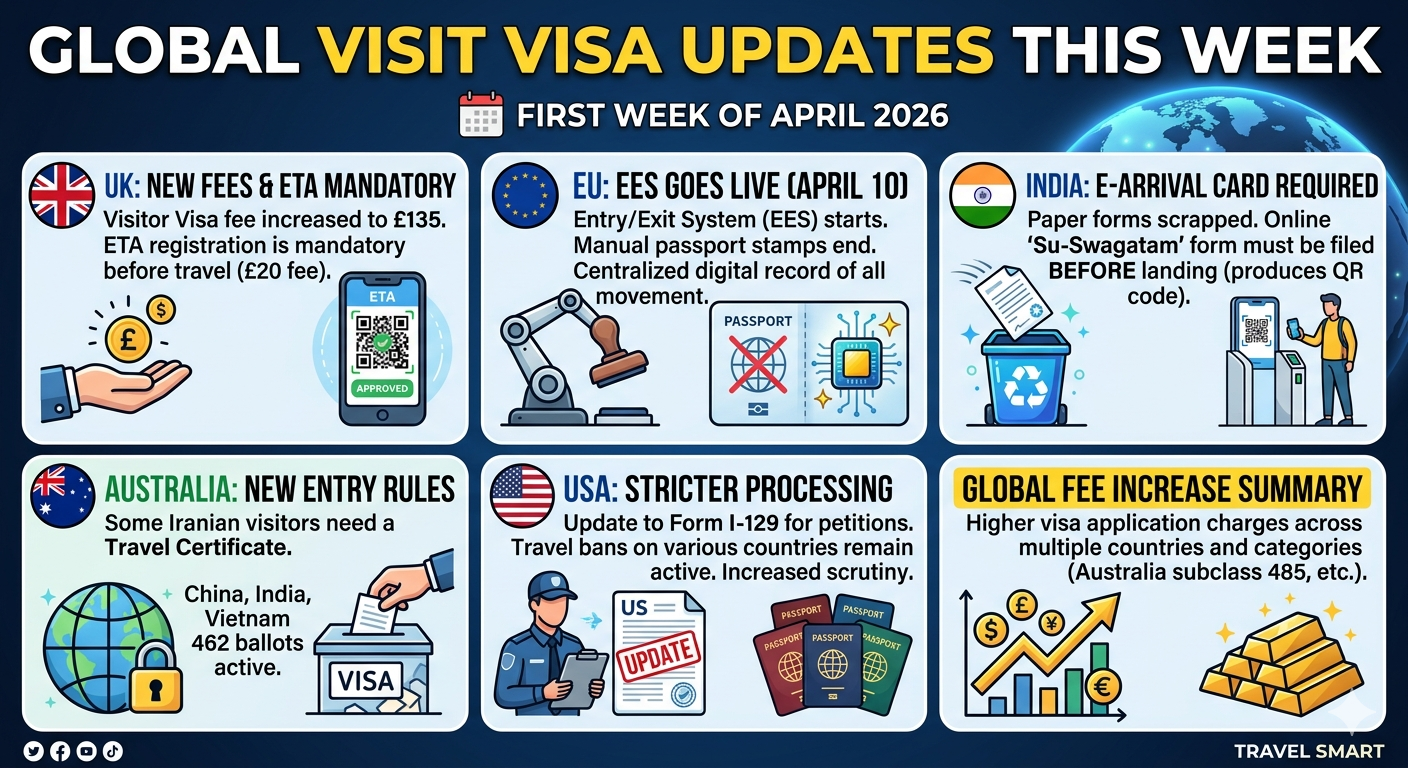
The most significant of all Visit Visa Updates This Week comes from the European Union. Starting April 10, 2026, the Entry/Exit System (EES) will become fully operational across 29 Schengen countries. This marks a historic shift in new visa regulations for the continent.
Digital Transformation: The Entry/Exit System (EES) officially replaces traditional manual passport stamping.
Biometric Requirements: Travelers must now provide facial images and fingerprints at the border.
Automated Tracking: The Entry/Exit System (EES) will automatically calculate the 90/180-day stay limit, flagging overstayers instantly.
Table: Impact of Entry/Exit System (EES) on Travelers
| Feature | Old System | New EES System (April 2026) |
|---|---|---|
| Record Keeping | Physical Passport Stamps | Centralized Digital Database |
| Data Collection | Visual Inspection | Facial Scans & Fingerprints |
| Overstay Detection | Manual Date Calculation | Automated System Alerts |
| Security | High Forgery Risk | Advanced Biometric Verification |
2. United Kingdom: Rising Fees and Mandatory ETA
The UK Home Office is making headlines in Visit Visa Updates This Week with a revised fee structure and the expansion of the Electronic Travel Authorisation (ETA). These visa policy changes are designed to modernize the border while increasing revenue.
ETA Fee Increase: Effective April 8, 2026, the Electronic Travel Authorisation (ETA) fee will rise to £20.
Visitor Visa Costs: The standard short-term visitor visa (up to 6 months) will increase from £127 to £135.
Mandatory Compliance: All visa-exempt travelers must have a valid Electronic Travel Authorisation (ETA) before boarding their transport. Without a confirmed Electronic Travel Authorisation (ETA), carriers are now legally required to deny boarding.
3. India: The Launch of the Digital e-Arrival Card
India has introduced a major update in this week's latest visit visa updates. As of April 1, 2026, the paper disembarkation form has been scrapped in favor of a mandatory digital e-Arrival Card.
Who Needs It: Every foreign passport holder, including OCI card-holders, must complete the digital e-Arrival Card before landing.
The Process: Travelers must file the form online via the "Su-Swagatam" app or the official portal to generate a QR code.
Benefits: Initial data shows that the digital e-Arrival Card reduces immigration clearance time from 6 minutes to under 3 minutes.
Grace Period: In response to Middle-East flight disruptions, India is also offering an automatic 30-day visa extension for stranded travelers whose visas expired after February 28.
4. Australia: New Restrictions and Ballot Systems
Australia continues to refine its new visa regulations with a focus on specific regions and high-demand categories.
Important Alert: An "Arrival Control Determination" is now in force. Most Iranian passport holders with a Visitor (Subclass 600) visa who were outside Australia on March 26 cannot use their visa unless they obtain a Permitted Travel Certificate.
Furthermore, the Work and Holiday (subclass 462) visa ballot for China, India, and Vietnam remains a focal point of latest visit visa updates. Registrations are being monitored closely as the current cycle approaches its April 30 closing date.
5. United States: Structural Shifts in Visa Processing
The US Citizenship and Immigration Services (USCIS) has introduced new visa regulations concerning petition filings.
Form Updates: All cap-subject petitions must now use the updated Form I-129.
Travel Ban Expansion: The visa policy changes initiated earlier this year remain in effect, with entry fully restricted for nationals of 19 countries and partially restricted for 20 others.
Increased Scrutiny: Applicants can expect more Requests for Evidence (RFEs) and a greater emphasis on financial legitimacy checks during the global visa screening process.
6. Summary of Global Visa Fee Changes (April 2026)
To help you budget for your next trip, here is a summary of the visa policy changes regarding costs:
UK ETA: Increased to £20 (effective April 8).
UK Visitor Visa: Increased to £135 (effective April 8).
Canada Permanent Residence: Fees rising for most economic streams (effective April 30).
Australia Subclass 485: 100% increase in the Visa Application Charge (VAC) for many applicants.
7. Preparing for the Global Visa Screening Process
With the latest visit visa updates emphasizing automation, the global visa screening process is now more rigorous. To ensure your application is successful, keep the following in mind:
Verify Intent: Immigration officers are using AI-supported tools to ensure your travel purpose matches your visa category.
Check Biometrics: Ensure you are prepared for fingerprinting and facial scans, especially under the Entry/Exit System (EES).
Digital Documentation: Always keep a digital copy of your digital e-Arrival Card or Electronic Travel Authorisation (ETA) on your mobile device.
Staying ahead of Visit Visa Updates This Week is the best way to avoid travel disruptions. Whether it is the Entry/Exit System (EES) in Europe or the digital e-Arrival Card in India, the transition to a fully digital border is officially here.
Would you like me to generate a checklist of the specific documents required for the new EU Entry/Exit System?
Related News
-

03-Oct-2025
The New Era of Umrah Pilgrimage: Stricter Rules and the End of Tourist Visa Reliance
-

22-Feb-2026
Malaysia Tour Packages Drive Record Tourism Growth in 2025
-

16-Oct-2022
Best Festival in the World
-

05-Aug-2025
Guide to Pakistan's Hajj 2026: Application Process, Dues, and Key Guidelines
-

22-Feb-2020
What is the Best Time to Visit Pakistan for Foreigner Tourist
-
11-Jun-2026
How the Latest Visa Reforms Will Impact Umrah Travelers
-

25-Aug-2020
Top Reasons That Fascinate The Tourists To Visit Pakistan
-
08-Nov-2021
Visa Free Entry for Pakistan
-

08-Apr-2025
Trump Travel Ban 2025: Pakistan Among Nations Facing Potential US Visa Suspension
-

02-Dec-2024
Hajj Application 2025 Pakistan - Last Date and Complete Guide
-

05-May-2025
Australia Skilled Independent Visa 2025 (Subclass 189): Your Comprehensive Points-Tested Stream Guide to Australian Permanent Residency
-

20-Nov-2025
Azerbaijan Visa Pakistan 2025 – Tourist & Urgent Apply
