
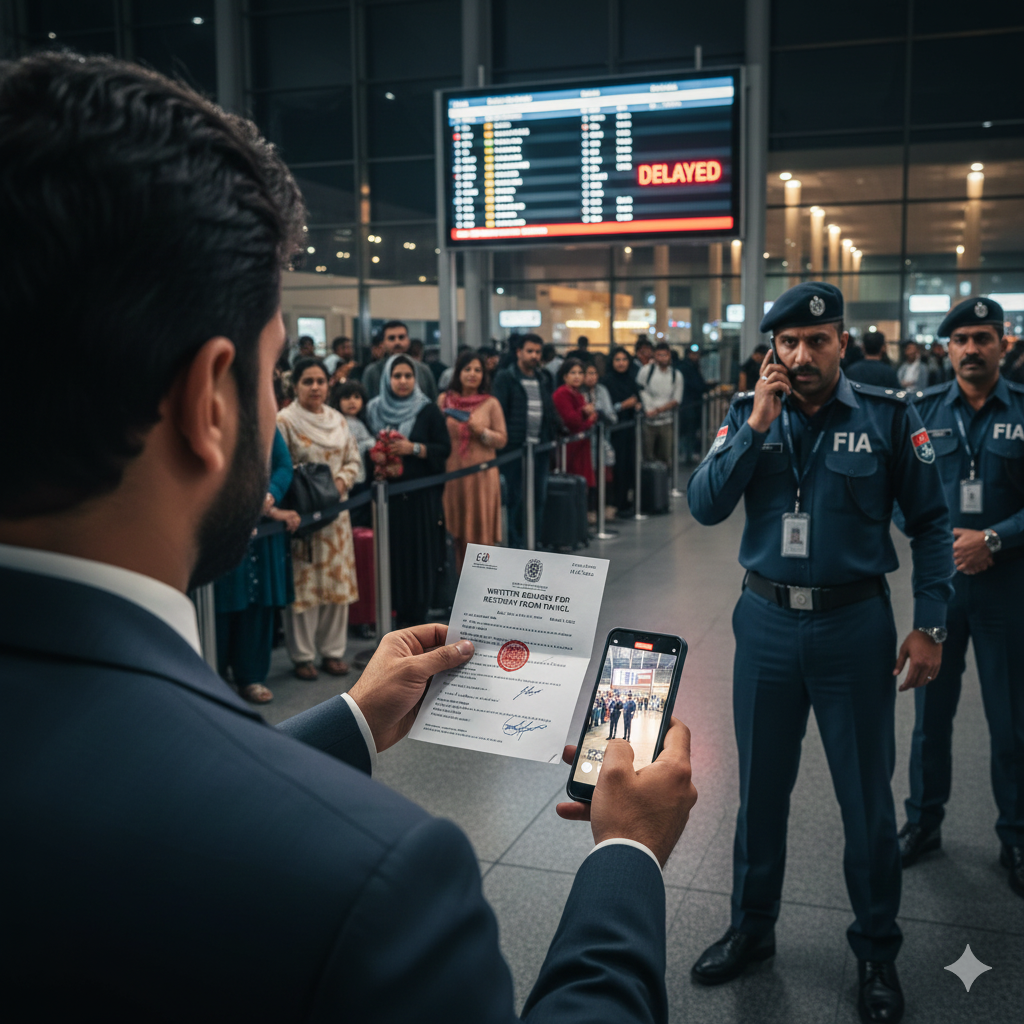
In a landmark ruling aimed at upholding civil liberties and procedural transparency, the Lahore High Court (LHC) has issued a stern reminder to state authorities: passengers offloaded or those restrained from travelling must be provided with written reasons.1 This directive serves as a significant check on the exercise of discretionary power by immigration and security agencies, ensuring that the fundamental right to freedom of movement is not curtailed arbitrarily.
The court's intervention highlights a recurring issue at international airports where travelers find themselves barred from boarding flights without clear explanations. By insisting that those restrained from travelling receive documented justifications, the LHC reminds authorities that the rule of law must prevail over administrative convenience.2
The Legal Context: Freedom of Movement
The right to travel is a cornerstone of personal liberty.3 When passengers offloaded from their scheduled flights are left in a state of legal limbo, it violates constitutional guarantees. The LHC reminds authorities that any restriction on movement must be backed by a valid, legal, and written justification.
Why Written Reasons Matter
Transparency: It prevents "blacklisting" based on hearsay or undocumented internal memos.
Accountability: Officials who decide that passengers offloaded should be barred must stand by their reasoning in a court of law.
Legal Recourse: A traveler restrained from travelling cannot challenge the decision without knowing the specific grounds for the restraint.
The Role of Immigration and Security Agencies
Federal authorities, including the Federal Investigation Agency (FIA) and the Ministry of Interior, often manage lists such as the Exit Control List (ECL) or the Provisional Identification List (PNIL).4 However, the LHC reminds authorities that simply having a name on a list does not absolve the state of the duty to provide a written explanation at the time of the incident.
Common Scenarios for Restraint
Exit Control List (ECL) Inclusion: Formal legal restrictions usually tied to ongoing criminal investigations.
Provisional Identification List (PNIL): A temporary measure that has often been criticized for lack of transparency.
Security Alerts: Immediate threats that may lead to passengers being offloaded for further questioning.
The LHC reminds authorities that regardless of the category, the individual restrained from travelling has a right to know "why."
Detailed Analysis of the LHC Directive
The Lahore High Court's observations came during the hearing of petitions filed by individuals who were stopped at the airport without prior notice.5 The court noted that the practice of verbally informing passengers offloaded of their status is insufficient and legally flawed.6
Procedural Requirements for Authorities
| Action Step | Requirement According to LHC |
|---|---|
| Identification | Officials must identify the specific list or legal order barring the traveler. |
| Notification | The traveler must be informed immediately upon being restrained from travelling. |
| Documentation | A formal document or letter stating the written reasons must be handed over. |
| Review | The document must include information on how the person can appeal the decision. |
By reinforcing these steps, the LHC reminds authorities that the "dignity of the citizen" must be respected even during security protocols.
Impact on "Passengers Offloaded"
When passengers offloaded from a flight are left at the terminal without documentation, they face immense financial and emotional distress. Non-refundable tickets, missed business opportunities, and family emergencies are all consequences of being restrained from travelling.
The Burden of Proof
The LHC reminds authorities that the burden of proof lies with the state. If a citizen is restrained from travelling, the state must prove that the restriction is necessary, proportionate, and lawful. Providing written reasons is the first step in establishing this legality.
Step-by-Step Guide for Travelers Restrained from Travelling
If you find yourself in a situation where you are being restrained from travelling at a Pakistani airport, the LHC reminds authorities—and by extension, the public—of the following rights:
Demand a Written Memo: Do not leave the immigration counter without asking for the written reasons for being offloaded.
Record the Names of Officials: Ensure you have the names and designations of the officers who have restrained you from travelling.
Note the Time and Flight Details: Maintain a log of the exact moment you were offloaded to calculate financial losses for potential litigation.
Contact Legal Counsel: Use the written reasons provided to file a writ petition in the High Court to have your name removed from any restrictive lists.
Constitutional Safeguards and the LHC
The Lahore High Court (LHC) serves as a guardian of the Constitution. The recent reminder that passengers offloaded must be given written reasons is rooted in Article 15 (Freedom of Movement) and Article 10-A (Right to Fair Trial).
When the LHC reminds authorities of these duties, it is essentially saying that the state's power is not absolute. A person restrained from travelling is still a citizen with rights, not a subject to be moved at the whim of the bureaucracy.
"The practice of offloading citizens without providing documented grounds is an affront to the judicial system. Every individual restrained from travelling deserves to know the case against them." — LHC Summary Observation.
The Economic and Social Toll of Being Offloaded
The phenomenon of passengers offloaded without warning has a ripple effect:
Airlines: Carriers face logistical hurdles and potential liability when passengers offloaded are removed at the last minute.
Tourism/Business: Arbitrary travel bans discourage international investment and damage the country's reputation.
Families: Many restrained from travelling are overseas workers or students whose entire careers depend on timely travel.
The LHC reminds authorities that these real-world consequences necessitate a high standard of procedural fairness. Providing written reasons ensures that mistakes can be corrected quickly and malice can be identified.
Conclusion: A Victory for Procedural Justice
The ruling that passengers offloaded or restrained from travelling must be provided with written reasons is a significant step toward a more transparent government. As the LHC reminds authorities of their obligations, it empowers the common man to stand up against administrative high-handedness.
Moving forward, it is expected that immigration desks will be equipped to provide immediate documentation to any traveler restrained from travelling. This change will not only reduce the number of passengers offloaded unfairly but will also streamline the legal process for those who truly belong on restrictive lists.
Would you like me to draft a template for a legal notice that can be used if you are restrained from travelling without written reasons?
Related News
-

12-Mar-2025
Umrah During the Last 10 Days of Ramzan 2025: Why It’s the Best Time to Go
-

13-Feb-2020
British High Commissioner Declared "Pakistan is Safe Country for Tourism"
-

11-Sep-2019
Tips to Find a Good Umrah Travel Agency in Pakistan
-

17-Sep-2025
Government's Proactive List of Certified Umrah Companies Combats Fraud
-

27-May-2025
Staying Healthy on Holy Ground: Singapore Updates Haj and Umrah Vaccination Requirements
-
02-Nov-2019
Madinah Airport
-
25-Jun-2025
Navigating Your Path to a Canadian Work Permit in 2025: A Comprehensive Guide
-

17-Dec-2020
How to Travel Safely During COVID-19 Pandemic?
-

29-Dec-2021
ITI Freight Train Service Pakistan’s Gateway to Europe
-

23-Jun-2020
Only Saudi Residents Will Be Able To Perform Hajj This Year: Saudi Government Announced
-
26-Mar-2022
Saudi Arabia to Offer Umra visitors High Speed Train Services and Grand Prix Event Visitors Free Transport Services
-
17-Oct-2024
UAE Visa Ban for Pakistan: Causes and Reopening
