
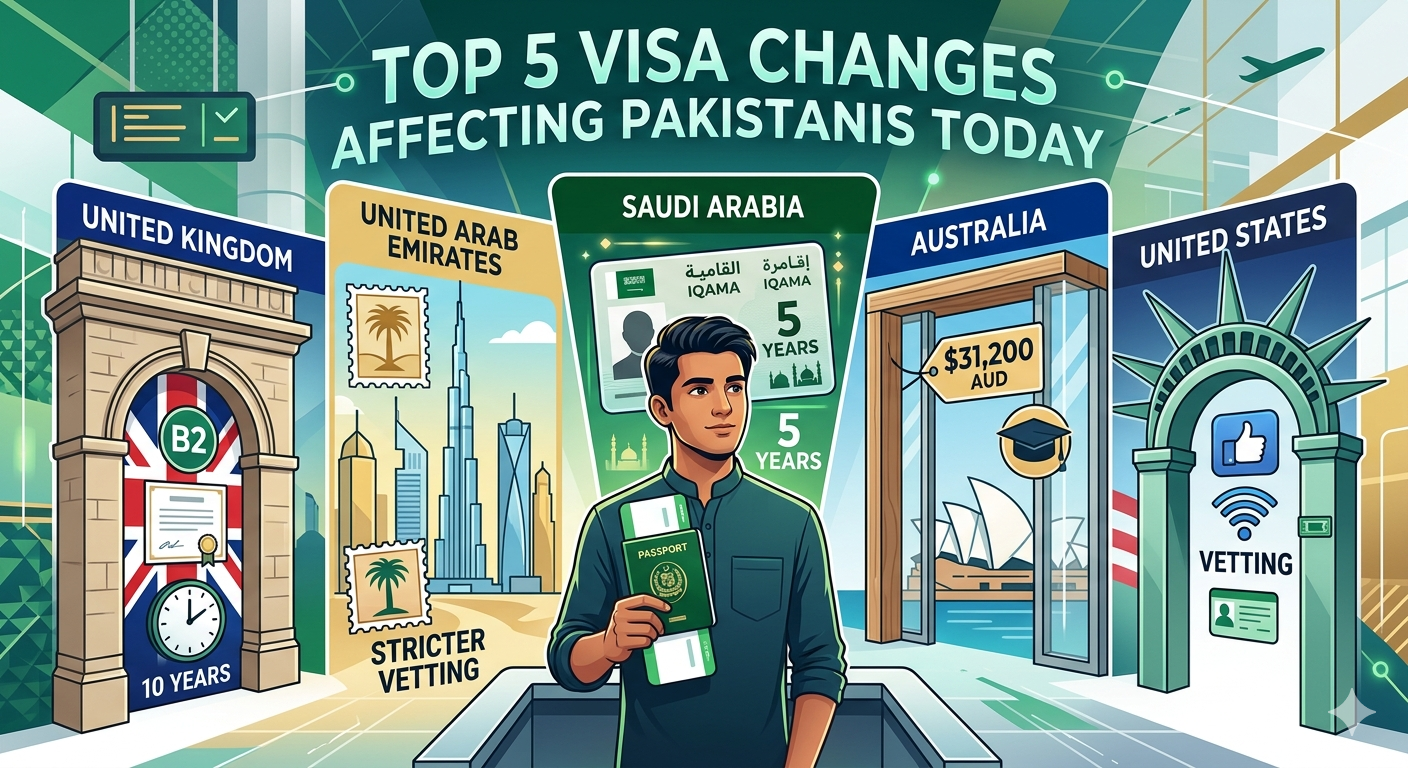
The landscape of international travel and migration is shifting rapidly for Pakistani citizens. As of April 2026, several key destinations—including the United Kingdom, United Arab Emirates, Saudi Arabia, Australia, and the United States—have implemented significant updates to their immigration policies. For Pakistani professionals, students, and travelers, staying informed is no longer a luxury but a compliance requirement.
From stricter financial thresholds to the digitalization of residency permits, these changes are designed to streamline processing while enhancing security. This article provides a detailed breakdown of the most critical visa updates you need to know today.
1. United Kingdom: The Shift to B2 English and 10-Year Settlement
The UK remains a top destination for Pakistani skilled workers and students, but the bar for entry and permanent stay has been raised significantly in 2026. Following the 2025 immigration white paper, the British government has tightened the "Skilled Worker" and "Student" routes.
Higher Language Standards
Perhaps the most immediate change is the requirement for higher English language proficiency. Previously, many visa categories required a B1 level (intermediate). As of January 2026, new applicants for Skilled Worker, Scale-up, and High Potential Individual visas must achieve a B2 level (upper-intermediate).
The Long Road to Settlement
The standard qualifying period for Indefinite Leave to Remain (ILR)—commonly known as permanent residence—is transitioning from five years to ten years for many migrants. However, there are "fast-track" reductions based on salary and contribution:
| Salary/Status | Settlement Period |
|---|---|
| Earnings over £125,140 | 3 Years |
| High-skilled (Public sector, health, teaching) | 5 Years |
| Standard Skilled Worker | 10 Years |
Note: Claiming public benefits or entering the UK via irregular routes can now extend the settlement waiting period by an additional 5 to 10 years.
2. United Arab Emirates: Stricter Vetting for Visit Visas
The UAE (specifically Dubai and Abu Dhabi) remains a primary hub for Pakistani tourists and job seekers. While visit visas remain "open," the approval process has become more rigorous in 2026 to ensure "quality tourism" and security.
New Documentation Requirements
Pakistani applicants must now provide more robust evidence of their intent to return. The "case-based" approval system means that even if you meet the basic criteria, additional background checks may be conducted. Key requirements include:
Financial Proof: Valid bank statements showing sufficient funds for the duration of the stay.
Confirmed Logistics: Both a confirmed return ticket and a valid hotel booking (or proof of a UAE-based sponsor's residence) are mandatory.
Entry Permits: Different durations are available, including 14, 30, 60, and 90-day permits.
Work Visa Openings
The UAE work visa is fully operational for Pakistanis but requires a valid job offer and a work permit approved by the Ministry of Human Resources and Emiratisation (MOHRE). The "visa hopping" culture—where tourists switch to work visas while onshore—is facing tighter scrutiny, and it is highly recommended to secure employment before arrival.
3. Saudi Arabia: The 5-Year Physical Iqama and Digital Reforms
Saudi Arabia has revolutionized its residency system in the first quarter of 2026. For the millions of Pakistanis living in the Kingdom, the "Muqeem" or Iqama system has undergone its most significant change in decades.
Decoupling the Card from the Status
The Kingdom has introduced a 5-year physical Resident ID (Iqama). Previously, a new card was printed every year upon renewal. Now, you keep the same physical card for five years, while your residency status is renewed annually via the Absher or Muqeem digital platforms.
Skill-Based Work Permits
Work permits are no longer just about your job title. They are now issued based on a five-pillar framework:
Educational background
Work experience
Professional skills
Wage level
Age
A mismatch between your "Mehna" (registered profession) on the card and your actual job role is now considered an active enforcement risk, potentially leading to fines or deportation.
4. Australia: The "Genuine Student" (GS) Requirement
For Pakistani students, Australia has replaced the old Genuine Temporary Entrant (GTE) test with a more rigorous Genuine Student (GS) requirement.
Financial and Academic Thresholds
The financial capacity requirement for the Subclass 500 Student Visa has increased to $31,200 AUD for the first year of living costs. This is a 12% increase from previous years, reflecting Australia's rising cost of living.
Post-Study Work Changes
The duration of the Temporary Graduate Visa (Subclass 485) has been recalibrated. While PhD holders still enjoy a 3-year stay, Bachelor’s and Master’s (coursework) graduates are now limited to 2 years. Furthermore, a new age limit of 35 years has been applied to graduate visas, though PhD and Research Master’s students are exempt up to age 50.
5. United States: Enhanced Social Media Vetting
The U.S. has implemented specific measures under Presidential Proclamation 10998 that directly affect Pakistani visa applicants in 2026.
Public Privacy Settings
Applicants for most non-immigrant visas (including H-1B, F-1, J-1, and K-1) are now instructed to adjust the privacy settings on all social media accounts to "public" or "open." This facilitates the mandatory vetting process necessary to establish eligibility.
Immigrant Visa Pause
Effective January 21, 2026, the Department of State has placed a temporary pause on certain immigrant visa issuances for nationals of countries with high rates of public assistance collection. This makes the vetting for "Public Charge" rules much stricter for Pakistani families seeking to relocate permanently to the U.S.
Summary of Visa Changes (2026)
| Country | Primary Change | Impact on Pakistanis |
|---|---|---|
| UK | B2 English Level | Higher entry bar for workers/students. |
| UAE | Stricter Vetting | Higher rejection rates for incomplete files. |
| Saudi Arabia | 5-Year Physical ID | Digital-first residency management. |
| Australia | $31,200 AUD Fund | Significant increase in financial proof. |
| USA | Social Media Vetting | Mandatory "open" profiles for security. |
In conclusion, the international community is moving toward a model that prioritizes high-skilled labor and financial self-sufficiency. For Pakistanis looking to travel or migrate in 2026, early preparation and meticulous documentation are the only paths to success.
Related News
-
14-Apr-2025
Umrah Entry Closed Until Further Notice in Saudi Arabia
-

18-May-2026
The Ultimate Guide to the Best Time to Perform Umrah with Less Crowd
-

30-Aug-2021
UAE Visit Visa
-
17-Sep-2019
How to Apply for Online Umrah Visa in Pakistan
-
17-May-2021
Kashmir Tour Packages
-

30-Jul-2025
The Group Travel Revolution: Reshaping Family, Adventure, and Eco-Tourism in USA, Australia, and New Zealand in 2025
-

23-Oct-2019
10 Cheapest Umrah Packages in Pakistan
-
07-Aug-2025
Turkey Tourist Visa: What Changed in 2025 for Pakistani Applicants
-

06-Mar-2025
Winter Wonderlands: Family Trips to Cozy Destinations
-
08-Jan-2021
Tanaqqol Best App for Pilgrims Book an Electric Cars
-

13-Jun-2020
Top 5 Benefits of Traveling, Why You Should Travel More in 2020
-

25-Apr-2020
How To Claim Compensation To Airline For A Cancelled Flight
