
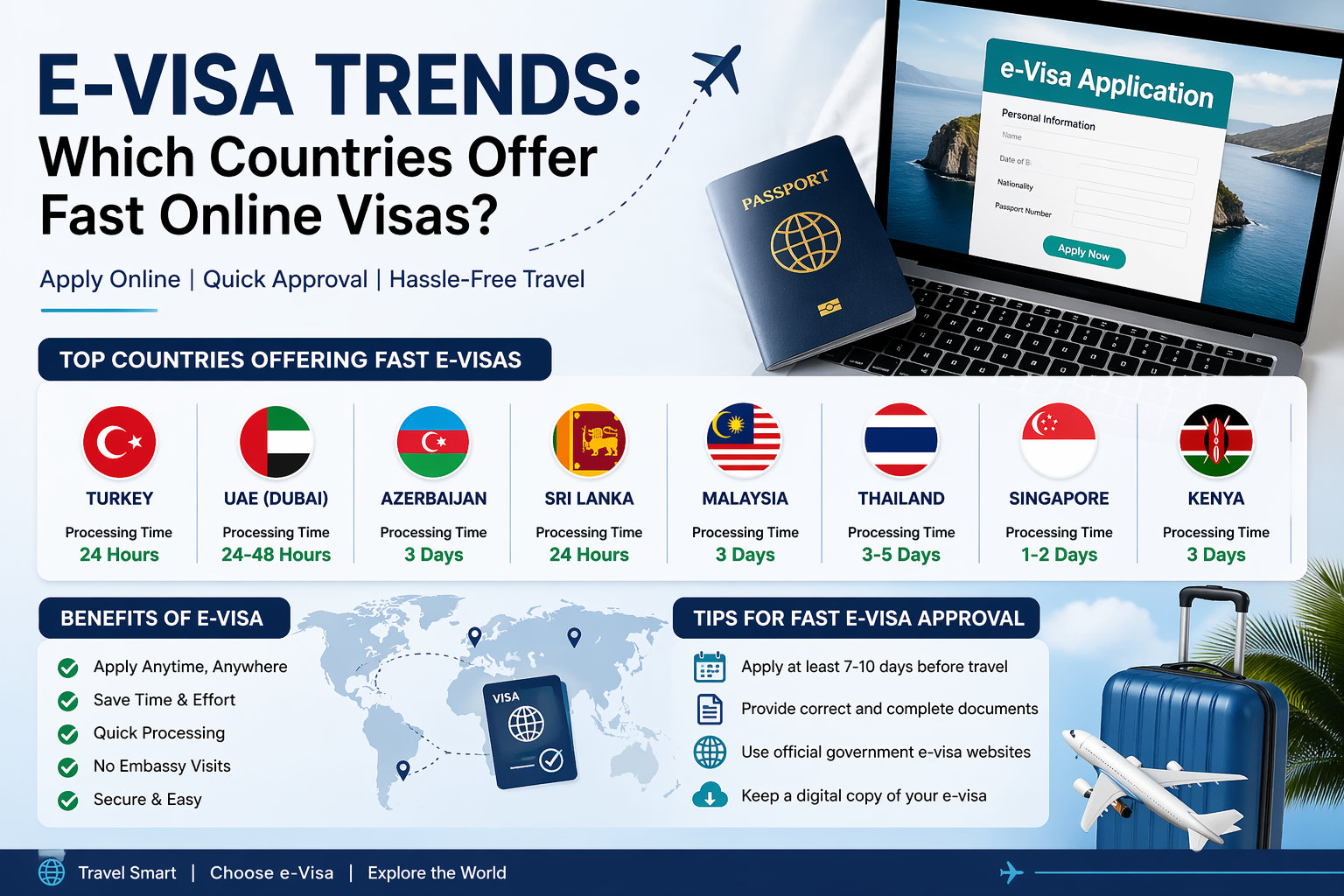
The global landscape of e-visas in 2026 is defined by a "race to the top" in digital efficiency. As the e-visa market surges toward a projected valuation of $4.06 billion this year, countries are no longer just offering online applications—they are competing on approval speed, often measured in hours rather than weeks.
The most significant trend this year is the rise of the "Super Priority" model and the expansion of specialized digital nomad pathways, which have matured from experimental pilots into permanent pillars of national immigration strategy.
1. The Speed Kings: Fastest Processing Times in 2026
Processing speed has become a key metric for national competitiveness. In 2026, several countries have optimized their back-end systems to provide nearly instantaneous decisions.
| Country | Fastest Service Tier | 2026 Processing Time |
|---|---|---|
| United Kingdom | Super Priority | 24 hours (after biometrics) |
| Australia | Visitor (Subclass 600/601) | < 1 day (automatic for many) |
| United Arab Emirates | Working Bundle / e-Visa | 24 – 72 hours |
| Singapore | Online Employment Pass | 10 business days |
| Latvia | EU Blue Card (Fast Track) | 5 working days |
The "Pay-for-Speed" Dominance
The UK remains the global leader in expedited processing through its tiered fee structure. For those willing to pay the premium (ranging from £500 to £1,000 extra), a decision is frequently rendered within one business day. Similarly, the UAE has unified 15 disparate steps into a single "Working Bundle" digital platform, reducing their work visa timeline significantly.
2. Emerging Trends: What’s Changing in 2026?
The Rise of "Slowmadism"
Digital Nomad Visas (DNVs) are moving toward longer stays. While 2024–2025 focused on short-term 6-month entries, 2026 data shows a 42% increase in stays longer than 90 days. Countries like Portugal and Spain have responded by offering pathways that explicitly lead to permanent residency (PR) after five years of remote work.
High-Value Selectivity
The days of "easy" $500-income visas are largely over. Governments are becoming more selective, targeting high-earning professionals:
Japan: Requires an annual income of ¥10 million (~€58,000).
Italy: Requires a minimum annual income of €24,789.
Spain: Threshold set at €2,760 per month.
Digital-First Student Pathways
Student visas are now almost entirely digitized in high-acceptance hubs. Finland and Malaysia lead here; Finland’s "Category A" permit now counts study time directly toward citizenship, with 82% of decisions made in under 30 days.
3. Best Countries for Fast E-Visas (By Category)
Australia’s ETA and the UAE’s tourist e-visa systems are largely algorithmic in 2026. Most travelers receive approvals within minutes to 48 hours.
Spain is currently ranked #1 for digital nomads due to its Beckham Law tax benefits (0% on foreign income). Malaysia is the "hidden winner" in Asia, with its DE Rantau program offering high certainty and rapid processing.
Germany’s Skilled Immigration Act has fast-tracked the EU Blue Card to a 2-week processing window, provided you have a recognized "Blocked Account" (Sperrkonto) of €11,904.
4. Avoiding Rejections in the AI Era
In 2026, many visa portals use AI-driven pre-screening. To ensure your "fast" visa doesn't turn into a "fast rejection," keep these three rules in mind:
Document Legibility: AI scanners often flag blurry uploads automatically. Use high-resolution PDFs, not phone photos.
Income Verification: Digital nomad and work visas now require rigorous proof. Bank statements must often be held for 28 consecutive days without the balance dipping below the threshold.
Health Insurance: This is no longer optional. Most e-visa systems (especially in the EU and UAE) will reject an application at the point of submission if a valid insurance policy number isn't provided.
Pro-Tip: If applying for a European "D" type visa (long-stay), always check if your chosen country allows you to switch from a tourist visa to a work/nomad visa while inside the country. Spain and Germany allow this; others require you to apply from your home consulate.
Related News
-

14-Sep-2019
How you can Get Maximum Benefits from any Travel Insurance Policy in Pakistan
-

01-Jun-2022
Pakistan Government has announced Hajj policy 2022 with subsidy
-

10-Sep-2022
A Memorable Visit to Kashmir: My Travelog
-
31-Oct-2024
Fly Jinnah Expands International Reach with New Routes to Saudi Arabia from Lahore
-

03-Jun-2026
New Transportation Facilities Introduced for Umrah Pilgrims
-

19-Jan-2026
Best Time to Book Umrah from Pakistan – Save Money in 2026
-
23-Dec-2025
Top 10 apps you must have during your umrah trip
-
04-Apr-2020
Why Social Distancing is a Big Failure in Pakistan?
-
.webp)
04-Jun-2025
our Comprehensive Guide to Umrah Packages from Germany 2025: Planning Your Sacred Journey Amidst New E-Visa Rules
-

16-Aug-2025
Massive Landslides, Flash Floods Imperil Tourists in North — Authorities Warn Against Travel
-

25-Aug-2020
Top Reasons That Fascinate The Tourists To Visit Pakistan
-

14-Feb-2022
New Saudi Umrah Visa Fees Pakistan and Rules 2022 Update
