
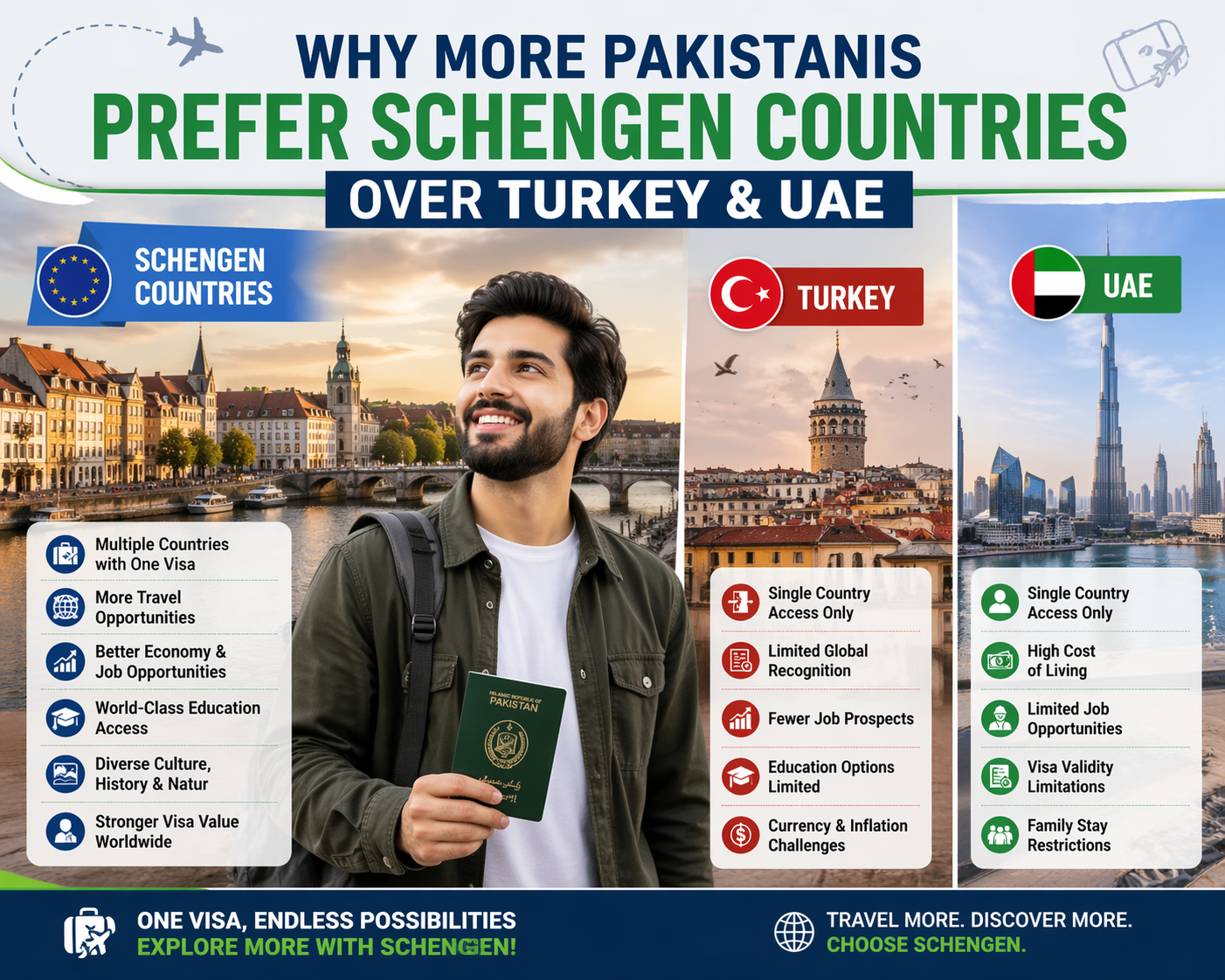
For decades, the trajectory of Pakistani emigration has been etched into a well-worn path: the oil-rich Gulf states of the United Arab Emirates (UAE) and Saudi Arabia served as the primary destinations for millions seeking to support families back home. These regions offered accessibility, geographic proximity, and a familiar cultural milieu. However, in recent years, a discernible shift has emerged. An increasing number of Pakistanis—ranging from high-skilled professionals and students to job seekers—are setting their sights on the Schengen Area.
This transition from the Gulf to Europe is not merely a matter of personal preference; it is a complex response to evolving economic, legal, and social realities. While the Gulf remains a major hub for labor, the appeal of Europe—characterized by pathways to permanent residence, higher quality of life, and long-term stability—has begun to outweigh the traditional lure of the Middle East.
The Mirage of Permanence: The Gulf’s Structural Limitations
The fundamental differentiator between the Gulf experience and the European experience lies in the concept of permanence. For the vast majority of Pakistani migrants in the UAE and other GCC nations, the stay is strictly temporary. The "Kafala" (sponsorship) system, though reformed in various ways over time, still largely ties a migrant's legal status directly to their employer.
No Pathway to Citizenship
In the Gulf, a migrant can work for thirty years, build a business, and contribute significantly to the local economy, yet they remain, legally, a foreigner. There is effectively no accessible pathway to permanent residency or citizenship for the average expatriate. For families, this creates a state of perpetual uncertainty. Children born and raised in the UAE often find themselves needing their own work visas upon reaching adulthood, facing the threat of deportation if they cannot secure one.
The Contrast with Europe
In contrast, many Schengen countries offer clear, codified pathways for long-term residency and, eventually, citizenship. For a Pakistani professional, settling in Germany, the Netherlands, or Scandinavian countries is not just about earning a salary; it is about building a life. The prospect of integrating into a society that provides a legal future for one’s children, access to world-class social security, and the right to permanent settlement is a powerful pull factor that the Gulf simply cannot match.
Economic and Educational Aspirations
While the Gulf was historically the destination for manual, construction, and service-sector labor, the profile of the modern Pakistani emigrant is changing. The rise of the educated, skilled Pakistani middle class has led to different priorities.
The Allure of Higher Education
Europe has positioned itself as a global leader in higher education. With its prestigious research-focused universities and, in many cases, affordable tuition fees compared to the US, Europe is a magnet for Pakistani students. Crucially, many European nations, such as Germany, have introduced "post-study work visas," allowing graduates to stay on and search for employment. This serves as a "soft entry" into the European labor market, turning a student journey into a career migration.
Career Scope and Professional Growth
For highly skilled professionals—IT experts, engineers, and healthcare workers—the career trajectory in Europe is often perceived as more robust and diverse. European companies tend to focus on long-term career development and offer a work-life balance that is increasingly attractive to a generation that values personal well-being alongside professional success. Furthermore, the European labor market is actively seeking to fill vacancies in specialized sectors, leading to more transparent and skill-based immigration policies.
Quality of Life and Social Integration
The definition of "success" for a Pakistani migrant is evolving. In the past, the singular goal was the maximization of remittances. Today, the focus has broadened to include the quality of life, political stability, and civil liberties.
Social and Cultural Environment
While the UAE provides a Muslim-majority environment that feels culturally closer to home, many Pakistanis are finding that the social, political, and economic freedoms in Europe offer a more sustainable environment for long-term growth. European societies are increasingly multicultural, and while challenges exist, the legal frameworks protecting human rights and equality are robust.
The "Safety Valve" Effect
Pakistan’s current economic challenges—characterized by high inflation, currency devaluation, and political instability—have created a "push" factor that encourages people to look for stability abroad. Europe is viewed as a "safe harbor" where hard-earned savings are less susceptible to the volatility of an unstable economy. The security of the European banking system, the transparency of the rule of law, and the public infrastructure all contribute to a sense of reliability that is highly valued.
The Challenges of the Shift
It is important to acknowledge that the path to Europe is significantly more difficult than the path to the Gulf.
Visa Barriers: Schengen visas are notoriously difficult to obtain. Requirements regarding documentation, bank statements, and travel history can be stringent. For the average worker, the barrier to entry is high, often leading to a reliance on intermediaries or, in desperate cases, dangerous irregular migration routes.
Cultural and Language Barriers: Adjusting to life in Europe—navigating a different language, a colder climate, and a vastly different social structure—is a daunting challenge compared to the relatively familiar environments of Dubai or Doha.
Market Saturation: While there is a need for skilled labor, the competition in Europe is global. A migrant is not just competing with other Pakistanis, but with talent from all over the world.
Conclusion
The preference for Schengen countries over the UAE and Turkey represents a fundamental shift in the aspirations of the Pakistani diaspora. It signals a move away from the "guest worker" model—where the goal is to earn money and return—toward a "settlement" model, where the goal is to build a secure, permanent future.
While the Gulf will undoubtedly continue to be a vital partner for Pakistan, providing essential employment for millions and generating significant remittances, it is being challenged by the promise of Europe. For those with the skills, the resources, or the academic drive, Europe represents not just a job, but the possibility of a life defined by stability, opportunity, and the freedom to grow. As the world becomes more interconnected, this trend is likely to intensify, marking a new chapter in the history of Pakistani migration.
Related News
-
22-Dec-2025
Why Umrah Travel is So Popular in Pakistan
-
27-Nov-2021
Best Beachs Tour Package in Pakistan
-
30-Jun-2021
Khanpur dam is best place to visit in hot summer
-
.webp)
26-May-2025
The Rising Tide of Schengen Visa Rejections: A Guide for Pakistani Travelers in 2025
-
.jpg)
09-Sep-2025
New Travel Policies Announced for Tourists Visiting Turkey in 2025
-
25-Feb-2026
10 Ways to Make the Best of Umrah in Ramadan
-
25-Jul-2020
How To Get Travel Insurance For Schengen Visa From Pakistan
-

20-Apr-2025
Riyadh Air Reveals Lavish Cabin Interiors Ahead of Late 2025 Launch
-
08-Apr-2025
Saudi Arabia Imposes Travel Ban on Pakistan, India, and 12 Other Nations Amid Hajj Season: New KSA Visa Policy Takes Effect April 13, 2025
-
06-Dec-2019
Best Places To Visit In Northern Areas of Pakistan During Snowfalling
-

19-Mar-2022
PIA International Increased Flight Fares for Umrah
-
18-Jan-2022
Canada Immigration Process for Pakistan
